
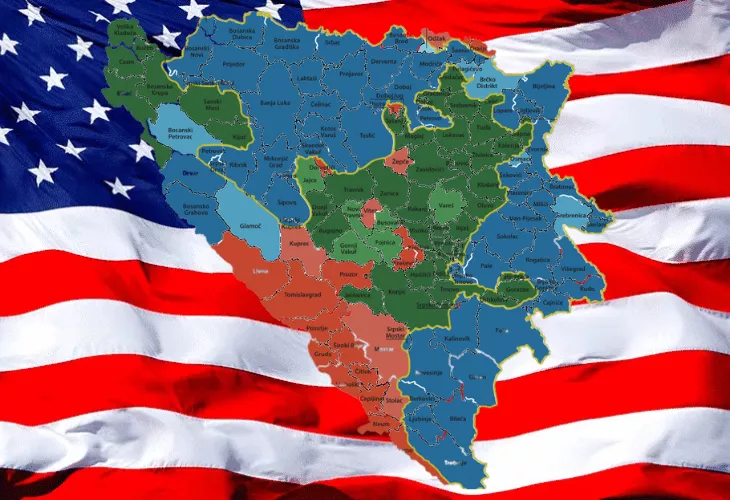
By Rasim Belko
The United States of America, as the most powerful actor in international politics in the post-war order, has not, in any strategic decision concerning Bosnia and Herzegovina in the last 35 years, acted in favor of its interests. On the contrary, all key political, military, and diplomatic decisions they have made have directly or indirectly worked to the detriment of Bosnia and Herzegovina, its territorial integrity, political stability, and the right of the people of Bosnia and Herzegovina to independently govern their country.
Starting from the moment the Yugoslav People's Army, with the help of Serbia, Montenegro, and paramilitary formations from Croatia and Serbia, launched an aggression against the internationally recognized Republic of Bosnia and Herzegovina, the USA sided with the wrong side of history. By participating in the imposition of an international arms embargo, they prevented the legal arming of the Army of the Republic of Bosnia and Herzegovina, and thus the right of the people to defend themselves against genocide, ethnic cleansing, and urban terrorism.
The embargo meant openly aiding the criminal armies of Republika Srpska, Serbia, and Montenegro, whose arsenals did not need replenishment, while units of the Army of RBiH were forced to survive the first months and years of the war with hunting rifles, improvised mortars, and occasional smuggled weapons. Numerous countries of the Muslim world, Turkey, Malaysia, Pakistan, Iran, and parts of Arab states, despite the threats from the international community, tried to help the besieged cities and fighters of the Army of RBiH, but even those connections had to be hidden, severed, or mediated, so as not to disrupt "strategic relations with the USA". During that time, America maintained tactical contacts with Belgrade, considering it an indispensable factor for a future solution to the "Yugoslav crisis".
The greatest absurdity occurred in mid-1995, when, after the Army of RBiH managed to consolidate its ranks, launch liberating offensives, and regain a significant part of the territory under its control, American diplomacy reacted urgently. They clearly stated that NATO planes would bomb the positions of the Army of RBiH if military operations were not halted. It was a practical threat of force against the legal army of an internationally recognized state, while NATO and the West had been silent about the genocide in Srebrenica, the massacres in Prijedor, Foča, Višegrad, and the siege of Sarajevo.
The Dayton Seal of Division and Hegemony
America's role in creating the Dayton Peace Agreement is the culmination of their wrong, selfish, and geopolitically cynical approach to Bosnia and Herzegovina. The Dayton Agreement was not a peace agreement; it was a ceasefire agreement that legalized the consequences of genocide and ethnic cleansing. On the territory created by mass crimes and expulsions, an entity structure was left in which the aggressor and the victim, under the pressure and supervision of the international community, were supposed to "democratically" build a state. The USA is directly responsible for the survival of Republika Srpska as an entity created on genocide, because it was a condition without which Milošević would not have sat down at the negotiating table.
From then until today, American policy has not allowed Bosnia and Herzegovina to develop internal consensus, nor have they allowed the creation of a stable political axis within the pro-Bosnian political corps. On the contrary, they have systematically maintained a state of permanent political crisis, pitting Bosniak parties against each other, creating media and analytical narratives that dehumanize anyone who opposes their frameworks, and imposing the view that no strategic decision in Sarajevo can be made without prior consultation with the American embassy.
The truth about the American hunt for paid political riff-raff, gathered by the former American ambassador and installed in positions of power, is continuously pushed aside by the narrative of the necessity of change. In reality, the installation of this political group in the last decade has been the biggest blow to the foundations of Bosnian statehood and independence. Because in order to bring to power those who think as the Americans say, they have overthrown the constitution and denied political rights to the Bosniak people. That is why the question for all of them who claim to be representatives of the Bosniaks is: how can America be your most important, and I would say your only ally, if after all this it has suspended your constitutional rights?
The long-term process of renouncing natural alliances is particularly dangerous. During the war, despite the embargo, there were countries that still risked helping: Iran, Malaysia, Pakistan, Turkey, and others. Instead of these relations being institutionalized and strengthened after the war, under direct American pressure, they were blacklisted. Bosnia and Herzegovina was imposed with the narrative that it must be an exclusive ally of the USA, even at the cost of its own damage. This has led to today's absurd situation where normal diplomatic contact with representatives of countries with which BiH has official relations is treated as a state scandal.
The latest example was the case of Minister Zukan Helez, who met with the ambassador of Iran. Although BiH has formal diplomatic relations with Iran, a meeting that is civilized and logical in any sovereign country was turned into a political-media lynching orchestrated by the American embassy, with domestic cadres from the Serb-Croat corps and the pro-Bosnian paid media apparatus as the main executioners. Helez made the wrong move not by meeting with the ambassador of Iran, but by later apologizing for something that is daily diplomatic practice in sovereign countries.
In Serbia, Vučić talks daily with Iranian, Chinese, and Russian diplomats, signs billion-dollar deals, receives Chinese loans and investments, and no one from Washington threatens him with sanctions or the overthrow of his government. On the contrary, Serbia is a "partner in the Western Balkans" for the USA, while Bosniaks are reserved the status of clients and a supervised people who are forbidden even to think about politics outside of given matrices.
We must not forget the fact that American diplomacy created Milorad Dodik and empowered him until he became a key political factor. Everything after that was a deception, because from the beginning of Dodik's career, the USA has erased leaders of multi-million countries from the face of the earth on the world's geopolitical map, and yet it couldn't deal with Dodik. Unfortunately, a spellbound Sarajevo believes that this is not the result of behind-the-scenes games around BiH, but of Dodik's strength on some kind of Russian wings.
American Alliance as a Means of Division and Disappearance of BiH
All this leads us to the fundamental problem: through three decades of false American alliance, Bosnia and Herzegovina has renounced all its friends, strategic partners, and independence. And what was once the law of normal survival – maintaining diplomatic, military, economic, and cultural ties with as many countries as possible – has today become forbidden territory. Bosniaks and Bosnians are the only people in Europe who do not have the right to a sovereign foreign policy. Behind the American alliance lies the intention to permanently keep Bosnia and Herzegovina in the status of a divided country, with entities as levers of ethnic destabilization, and without the possibility of creating a true state consensus about the future.
Anyone who tries to raise the issue of returning sovereignty, redefining Dayton, or building relationships with external partners outside of American interests is publicly lynched, accused of radicalism, Islamism, anti-Americanism, or destabilization. Thus, not only politics but also public consciousness is controlled, turning the entire society into a hostage of foreign embassies and domestic traitorous elites.
Therefore, the meeting of Minister Helez with the Iranian ambassador is not the problem. The problem is that Bosniaks and Bosnians have their hands, feet, and brains tied so they don't even think about an alternative path. Because then they would realize that the path under the umbrella of the American alliance is not a path to salvation, but a path to the slow, quietly organized disappearance of Bosnia and Herzegovina as a sovereign state. And this is not a geopolitical misfortune, but an American strategy that has been in place since the beginning of the aggression until today.
Komentari (0)
Prijavite se za komentiranje
PrijavaJos nema komentara. Budite prvi!
Minuta
Sve →Iz drugih kategorija

High Representative Not Elected: Germans, French and British Sabotaged Americans, New Attempt at End of June

ČOVIĆ WITHOUT MERCY: How Those Who Brought Ademović to Office Created a Political Hell for Him



Sunny Saturday, quite warm



Tragedy in Albanian resort: Two minors drown












