
Interview by Delvin Kovač
Serbian President Aleksandar Vučić has made a decision to increase the number of special units of the Serbian Army. Among other things, the decision, which contains four points, states that the organizational structure of the peacetime and wartime organization of the special forces of the Serbian Army should be upgraded to the projected strength.
Who is Vučić preparing for, what kind of message is he sending to his neighbors with this, and what is his general assessment of the current security situation in the region? Military analyst from Bosnia and Herzegovina, Nedžad Ahatović, spoke about this in an interview with the Patria News Agency.
How do you comment on this decision by Serbian President Aleksandar Vučić?
Ahatović: Fundamentally, the concept of organizing a part of the army in a country in terms of structure, training, and equipment of special operations brigades gives that political establishment the ability to resolve a potential crisis without provoking a general war. In the event of a general war, special operations brigades become strike forces for tactical support or rapid response for your armed forces, which can be used from the sea, air, and land.
Serbia already has such a concept, albeit limited, as the Serbian Army already has the organized 72nd Special Operations Brigade and the infamous 63rd Parachute Brigade, as well as the "Kobre" Military Police Detachment.
Increasing the number of special units can mean that existing units will be further staffed and deployed to more important points in Serbia, as the 72nd is stationed in the Pančevo garrison, and the 63rd is traditionally in Niš. It can also mean the formation of additional special units and their new strategic deployment, but this entails additional costs.
The multi-year and constant training of a special forces soldier is on par with the constant training and education of military pilots, which are astronomical figures, over 5 million US dollars annually according to RAND Corporation data. It involves very complex and sophisticated training at sea (rivers), in the air, and on land in all weather conditions.
One example is enough to see the scale of the activity. Namely, such soldiers must fire over 50,000 rounds of small-caliber ammunition annually in various close combat exercises, situational exercises, obstacle courses, etc. Conclusion - more special forces, more funds for the training of the Serbian Army, but also greater capabilities, from suppressing riots and all kinds of political internal instability to guiding armed drones to the enemy's key targets.

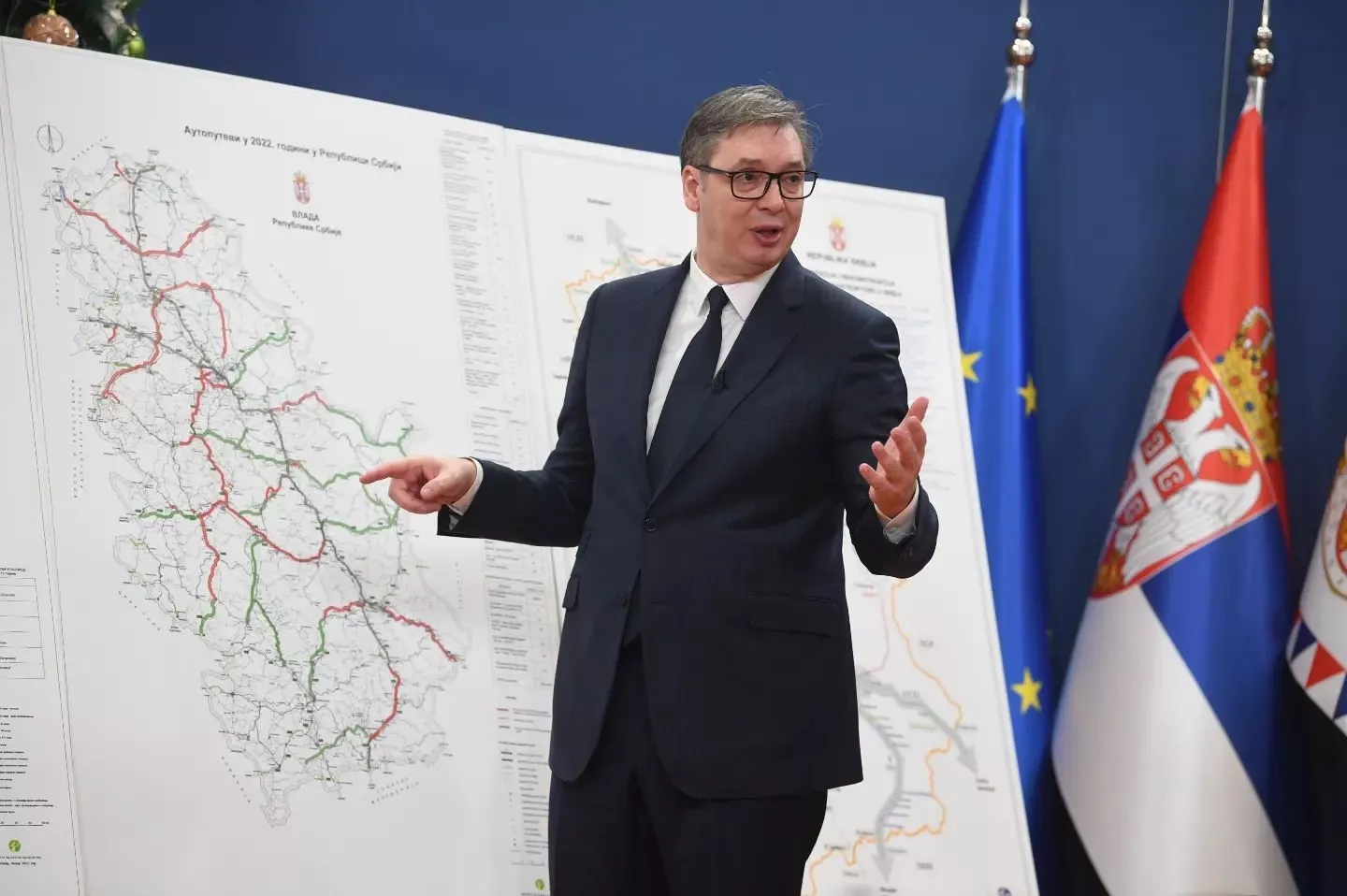
The decision made by Serbian President Aleksandar Vučić (Photo: RTS)
Who is Vučić actually preparing for? Did he make this decision because of his neighbors or the internal situation in Serbia itself?
Ahatović: Given all of the above, Vučić clearly fears the provocation of internal instability in Serbia, both from the West and, indeed, from the very strong Russian element that exists and operates in Serbia, completely autonomously from him and his political goals.
If he turns his back on one or the other, there is a possibility that he will be removed by a coup, demonstrations, or even, in the case of the Russians, an assassination, like those bizarre cases of Russian tycoons disappearing. There are elements of intimidation of neighbors as well, of course. Any strengthening of the army is a hybrid threat that is publicly displayed, thus signaling to potential adversaries the military power of Serbia.
Let me say right away that this military power is not insignificant compared to the neighbors. For example, Serbia is in the process of de-conserving 100 T-55 tanks from storage, because this tank is mechanically simpler than others in the Serbian Army's arsenal and cannot be significantly delayed due to sanctions on spare parts, as Serbia has twice as many of these tanks in storage from which all necessary spare parts can be obtained. When these tanks are also operational, Serbia will have almost 400 tanks ready to move, as it already has over 280.
What message is Vučić sending to his neighbors with such a move?
Ahatović: That, in addition to the spent and donated 5 billion euros on military strengthening, he is preparing for a conflict in the "Serbian world" zone, i.e., in Montenegro, Kosovo, or our entity of Republika Srpska, which is, after all, the goal of the national military defense strategy of the Republic of Serbia. That document consists of seven national goals, among which military neutrality and "care for all Serbs wherever they live" are emphasized. It literally states that preserving Republika Srpska, as an entity within Bosnia and Herzegovina, in accordance with the Dayton Agreement, and improving the position of Serbs in the region and the world are of special importance for the security and defense of the Republic of Serbia.
In the case of BiH, this is a document of open territorial pretensions, and in a "military-defense" sense. Republika Srpska is considered part of Serbia's territory in the concept of defense by all available military means, with "full respect for the Dayton Peace Agreement and the territorial integrity of BiH," and always without mentioning our state sovereignty. So, the situation is clear.
How do you generally assess the current security situation in the region, who is the biggest threat to regional security?
Ahatović: The security situation is only in a state of apparent stability. The region is designated as having a high degree of risk of conflict outbreak for NATO, with Bosnia and Herzegovina being particularly highlighted as having all the prerequisites to become a victim of Russian hybrid warfare. Namely, space is being created for Russian proxy forces, i.e., hybrid guerrillas as in Luhansk and Donetsk, to be armed and equipped for low and medium-intensity armed conflicts. After all, an entire study on the secession of Republika Srpska from BiH in political and military terms has been prepared, and even publicly presented in articles titled "The Case of Artsakh (Nagorno-Karabakh) and the Defense of R. Srpska," authored by Dr. Nebojša Vuković, a collaborator of the Institute for International Politics and Economics from Belgrade in 2021.
Montenegro and BiH are closest to chaos and conflict. Montenegro due to the constant escalation of political disagreements and the artificial division between Serbs and Montenegrins instigated by Moscow, the Serbian Orthodox Church, and Belgrade. And BiH due to Milorad Dodik, who is marching towards the independence of Republika Srpska, by hook or by crook, also supported by the same trio. Kosovo is not outside the danger zone. Kosovo, unlike BiH and Montenegro, is not a state with international recognition, but it does not have legitimate elements of political or administrative division within Kosovo, except for the ZSO guaranteed by the Brussels Agreement in the north of the country.

Ahatović: Vučić fears internal instability (Photo: Facebook)
Any rebellion of Serbs in Kosovo is unlawful and illegitimate, as is any other, while in BiH it is defined by the entity's political structure, de facto broad autonomy up to secession which is forbidden by Dayton, and in Montenegro by the political majority legitimacy supported by the religious community.
From all these moves, one can read Belgrade's organization. The goal is to gain an advantage in the process of negotiations on resolving the status of Kosovo. The advantage is considered in the possibility of provoking a conflict for Russian interests in the Balkans. The US wants to prevent this, as it prevents the internationalization of the conflict in Ukraine and its spillover into Europe. It seems that no means are being spared to persuade Belgrade to abandon Moscow politically and in every other sense. This is where the concept of overthrowing ruling structures in the Balkans, which are corrupt, comes from, as if they weren't before. This approach has not a shred of American foreign policy weight based on Joseph S. Nye Jr.'s "Smart Power."
Such an approach, of course, gives the Russians new momentum in the Balkans, where, through the so-called Mirror Strategy via Euro-rightists and their conspiracy theories and sowing fear of a Muslim majority in BiH, they are pushing the West to do what they failed to achieve through war and years of influence in the Balkans. This is no longer extermination, but the separation of Bosniaks from Western values, for which they survived genocide while fighting for these values during the aggression against BiH.
Of course, the Euro-rightists, although disdained by the Biden administration, are rejoicing because, with the help of Croatia, they have politically limited Bosniaks (Muslims) through the decisions of the OHR, i.e., Christian Schmidt, on amending the Constitution of FBiH and the Election Law of BiH, thereby favoring HDZ BiH. Similar things, albeit in a different political connotation, are happening in Montenegro and Kosovo. With such an approach, even with the best intentions, the Americans are fundamentally losing moral and political ground, compromising their foreign policy principles and goals, and more importantly, they are not reducing Russia's chances of provoking a conflict in the Balkans, if they so desire.
One example is enough to understand the scale of the mistake Washington is making. Milorad Dodik is on the US blacklist, i.e., OFAC (US Treasury Department's Office of Foreign Assets Control). Yevgeny Prigozhin, the leader of Putin's "Wagner" death squad, is also on the same list for two reasons related to the war in Ukraine. No one from the US administration talks to him, he has no dealings with any US institution. On the other hand, Milorad Dodik is a desirable partner for forming government in BiH, and US ambassadors to BiH and Gabriel Escobar, the US Special Envoy for the Balkans, regularly meet with him...
You know, one should not be fooled: both Prigozhin and Dodik have the same goal - the creation of a Russian world and the same boss, Vladimir Vladimirovich Putin, who, incidentally, is also on the same list with the same company. Making a pact with the devil is a dirty business. In Goethe's "Faust," Faust, after making a pact with the devil and acquiring all the knowledge in the world, mocks Wagner for his belief in long-acquired knowledge, and whom the Russian "Wagner" will mock in the Balkans, we shall see.
Komentari (0)
Prijavite se za komentiranje
PrijavaJos nema komentara. Budite prvi!
Minuta
Sve →Iz drugih kategorija

High Representative Not Elected: Germans, French and British Sabotaged Americans, New Attempt at End of June

ČOVIĆ WITHOUT MERCY: How Those Who Brought Ademović to Office Created a Political Hell for Him



Sunny Saturday, quite warm



Tragedy in Albanian resort: Two minors drown












