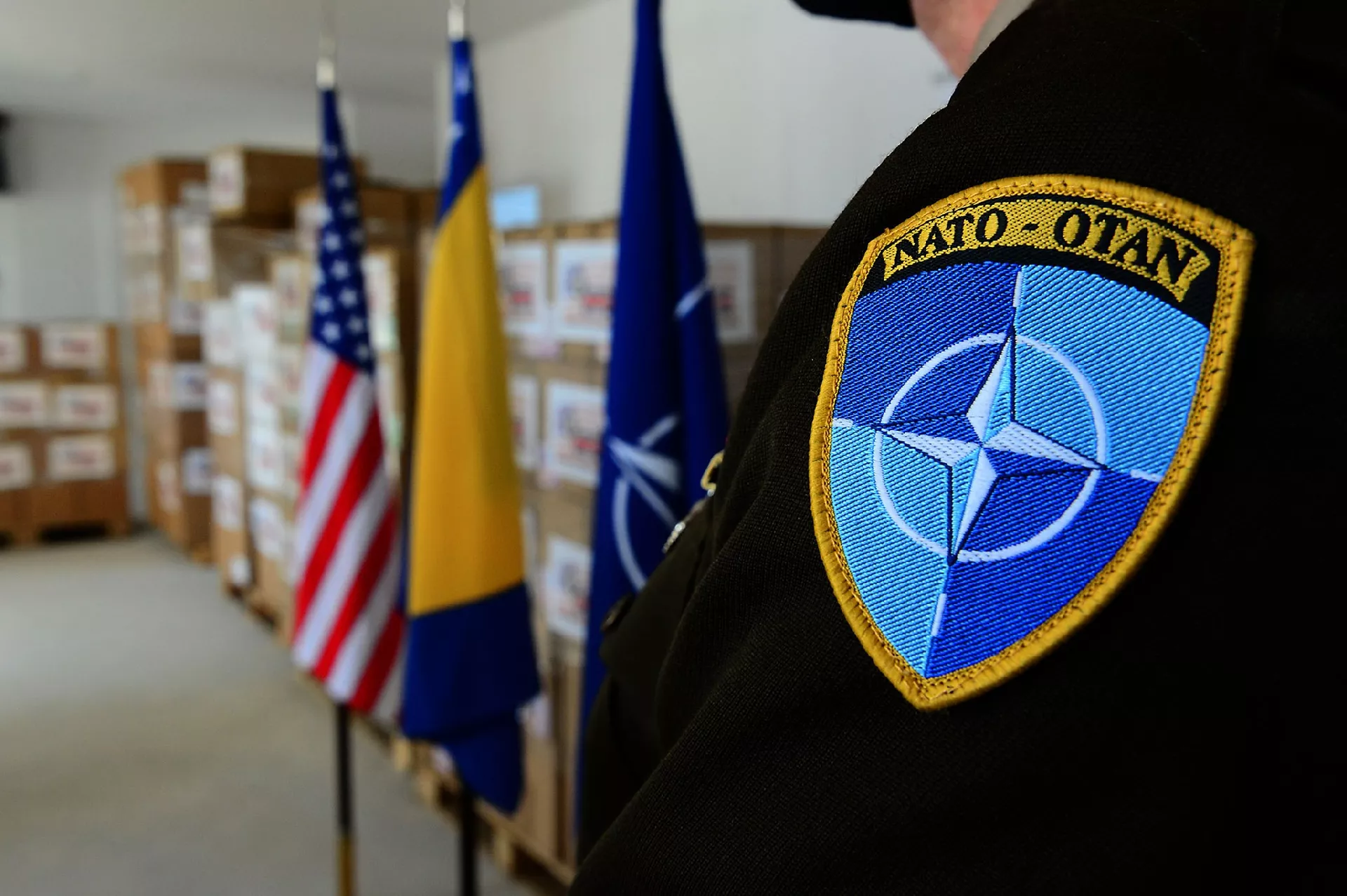
(Patria) - The Center for Security Studies (CSS) conducted a survey of citizens' attitudes towards NATO from September 15 to 22, 2025.
The research was carried out via an online survey questionnaire, conducted throughout Bosnia and Herzegovina, and the sample of respondents included 601 people.
Men constitute 83% of respondents, 14% are women, while 3% did not state their gender. 64% of respondents are from the Federation of BiH, 25% from Republika Srpska, 3% from Brčko District of BiH, and 8% did not state their place of residence.
In terms of age, the largest percentage of respondents, 45%, belongs to the group aged 18 to 35, followed by those aged 36 to 49 (26%). Almost a quarter of respondents (24%) are aged 50 to 64, and the smallest group is over 65 years old (5%).
To the first question, "Can BiH be secure in the long term without full membership in NATO?", the largest percentage of respondents, 53%, stated that it is not possible. On the other hand, 40% of respondents believe the opposite, i.e., that BiH can be secure in the long term without full membership in NATO. Only 7% did not know how to answer this question.
The second question, "Do you think there is a better guarantee for citizens regarding peace and security in BiH than NATO membership?", shows a similar distribution of answers. 43% answered affirmatively, while 51% believe there is no better guarantee for peace and security in BiH than NATO. Respondents who did not know or did not want to answer this question accounted for 5%.
The third question of the survey questionnaire concerned budget allocations for the Armed Forces of BiH and read "Do you support the increase in funds allocated to the army proposed by the Presidency of BiH?". The majority of respondents, 63%, support the proposal of the Presidency of BiH. One-third of respondents do not support this proposal, while 4% did not answer this question.
The last, fourth question was "What do you think is most important for citizens' security in the future?". Of the multiple offered answers, the most respondents, 38%, chose NATO membership as the most important for citizens' security in the future. They are followed by those, 22%, who believe it is EU membership. In third place, almost a fifth of respondents (19%) consider BiH's neutrality as the most important approach for citizens' security in the future, while 13% believe it is regional cooperation. 7% of respondents believe it could be some other military alliance. The fewest respondents who did not offer an answer to this question were 1%.
The findings of the survey clearly confirm that security issues are at the very center of interest, as well as socio-political dilemmas in BiH. A similar trend is recorded in research conducted by the EU, whose citizens expressed the greatest concern in the area of security and stability.
Although there is a non-negligible percentage of citizens who prefer alternative models, such as neutrality or some other military alliance, the majority of respondents recognize NATO membership, i.e., Euro-Atlantic integration, as a key prerequisite for long-term security.
The CSS assumes that such attitudes were influenced by the broad and demanding discussions within NATO member states about the future and significance of NATO's survival in this format, despite contemporary challenges.
Such attitudes gain particular significance at a time when BiH is experiencing stagnation on its EU, and especially NATO path, facing deep internal political divisions and exposed to an increasingly complex regional and global security environment.
By expressing support for increasing the military budget, in line with international trends and commitments, one gets the impression that citizens are more aware of the tectonic shifts in the international order than the political elites in BiH are.
The symbolic increase in the budget of the BiH Ministry of Defense has provoked a barrage of opposing views within political circles, and the percentage of BiH citizens who express understanding for such a decision indicates that they are in solidarity with their Euro-Atlantic friends who believe that challenging times require difficult and brave decisions.
An additional value to the research results is given by the fact that the majority of respondents belong to the younger and working-productive category of the population oriented towards the future, which should be a clear and unambiguous signal to all political subjects in BiH. In this regard, public opinion should not be understood as a mere reflection of citizens' perceptions at a given moment, but must represent a strategic imperative for decision-makers.
The issue of the country's security orientation, which determines BiH's international position in the long term, must not be left solely to politicians who seem more oriented towards the past than the future. The clear commitment of citizens, especially young people, i.e., their understanding, wisdom, and determination in expressing their views, must be a guide and a clear roadmap for those to whom the trust of these same citizens has been entrusted to govern the country in their name," the CSS stated.
Komentari (0)
Prijavite se za komentiranje
PrijavaJos nema komentara. Budite prvi!
Minuta
Sve →Iz drugih kategorija

Visoki predstavnik ni izbran: Nemci, Francozi in Britanci proti Američanom, nov poskus konec junija