Written by: Hayat.ba
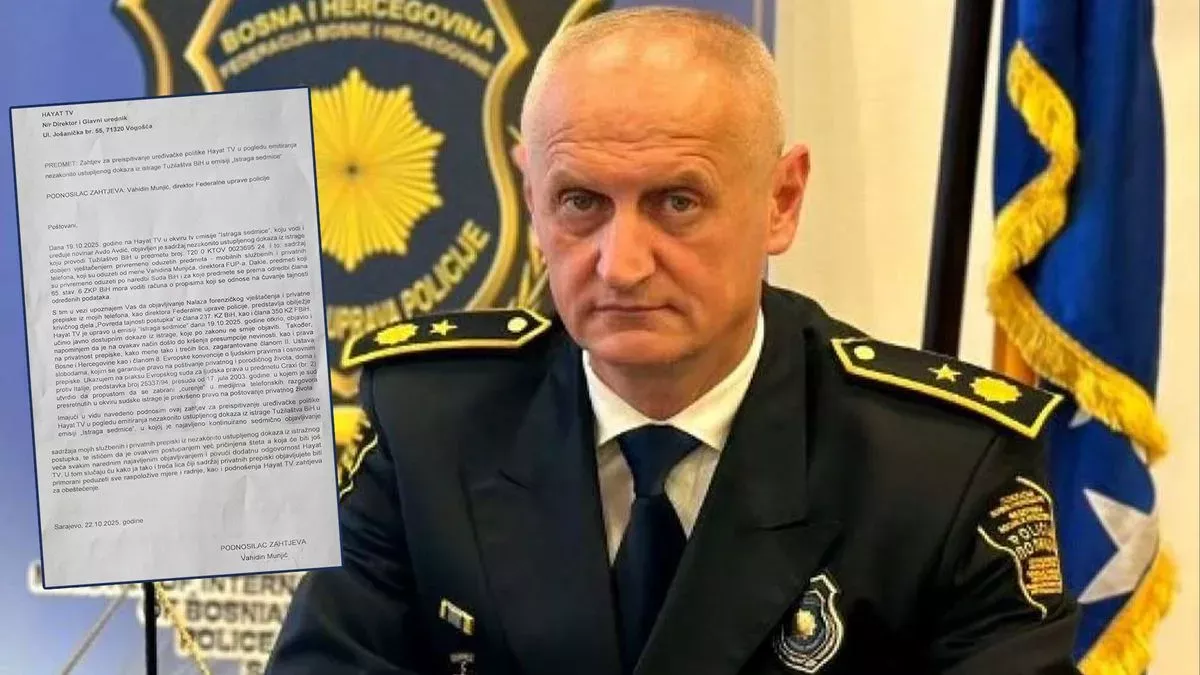
Vahidin Munjić, who claims to be the director of the Federal Police Administration (although he has been acting director of the FUP for a long time), addressed Hayat TV after his and correspondence of the Prime Minister of the Federation of BiH Nermin Nikšić and several other individuals were published in the show 'Investigation of the Week'.
Munjić sent a 'Request for Reconsideration of Hayat TV's Editorial Policy Regarding Broadcasting', which he stated was an 'illegally provided piece of evidence from the investigation of the BiH Prosecutor's Office in the show 'Investigation of the Week''.
We are publishing his request in its entirety:
Dear Sir/Madam,
On 19.10.2025, on Hayat TV, within the TV show "Investigation of the Week", hosted and edited by journalist Avdo Avdić, the content of illegally provided evidence from the investigation conducted by the BiH Prosecutor's Office in case number: T20 0 KTOV 0023695 24 was published. Specifically, the content obtained from the forensic examination of temporarily seized mobile phones, both official and private, which were seized from me, Vahidin Munjić, director of the FUP. Therefore, items that were temporarily seized by order of the BiH Court and for which, according to Article 65, Paragraph 6 of the Criminal Procedure Code of BiH, regulations concerning the confidentiality of certain data must be taken into account.
In this regard, I inform you that the publication of the Forensic Examination Findings and private correspondence from my phones, as director of the Federal Police Administration, constitutes the criminal offense of 'Violation of Procedural Secrecy' under Article 237 of the Criminal Code of BiH, as well as Article 350 of the Criminal Code of the Federation of BiH. Hayat TV, in the show "Investigation of the Week" on 19.10.2025, revealed, published, and made publicly available evidence from the investigation, which by law it is not allowed to publish. Furthermore, I note that this action violated the presumption of innocence, as well as the right to privacy of correspondence, for both myself and third parties, guaranteed by Article II of the Constitution of Bosnia and Herzegovina, as well as Article 8 of the European Convention on Human Rights and Fundamental Freedoms, which guarantees the right to respect for private and family life, home, and correspondence. I point to the case law of the European Court of Human Rights in the case of Craxi (no. 2) v. Italy, application no. 25337/94, judgment of July 17, 2003, in which the Court found that the failure to prohibit the 'leakage' of telephone conversations intercepted during a judicial investigation into the media violated the right to respect for private life.
In view of the above, I submit this request for reconsideration of Hayat TV's editorial policy regarding the broadcasting of illegally provided evidence from the investigation of the BiH Prosecutor's Office in the show "Investigation of the Week", in which the continuous weekly publication of the content of my official and private correspondence from illegally provided evidence from the investigative procedure has been announced, and I emphasize that such actions have already caused damage and will cause even greater damage with each subsequent announced publication, and will entail additional responsibility for Hayat TV. In that case, both I and third parties whose private correspondence content you publish will be forced to take all available measures and actions, as well as to file claims for compensation against Hayat TV – states the request signed by the acting director of the FUP, Vahidin Munjić.
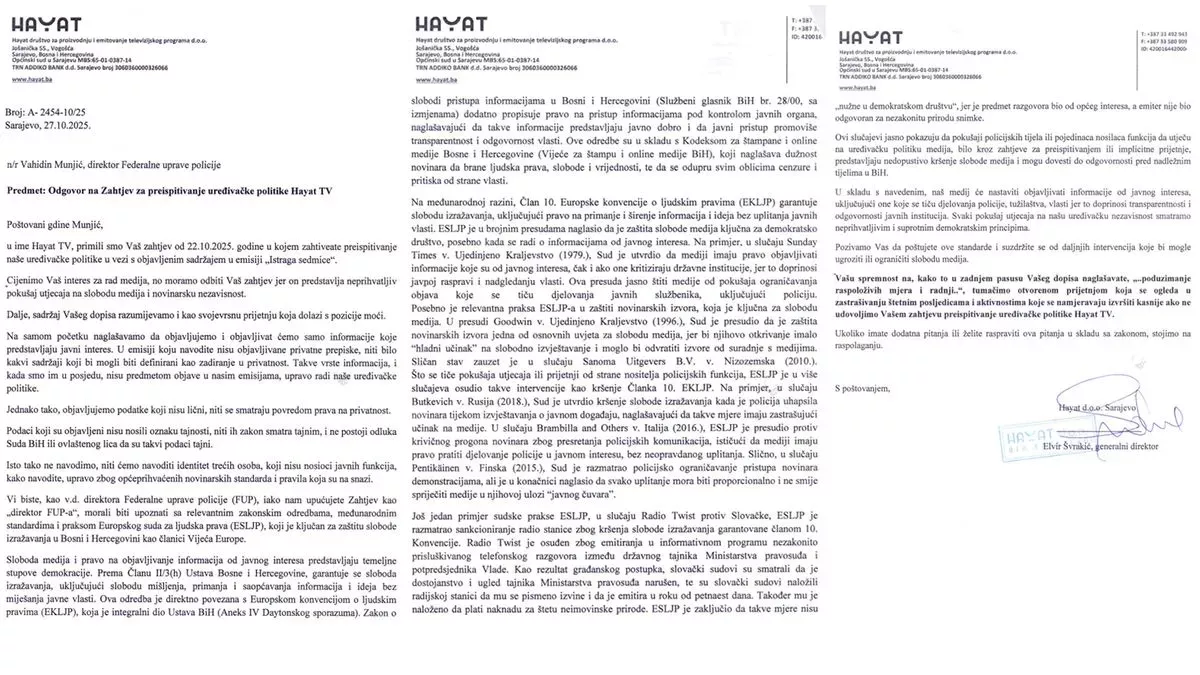
Below, we publish the response of the General Director of Hayat Television, Elvir Švrakić, to Munjić's Request:
Dear Mr. Munjić,
On behalf of Hayat TV, we have received your request dated 22.10.2025, in which you request a reconsideration of our editorial policy regarding the content published in the show "Investigation of the Week".
We appreciate your interest in the work of the media, but we must reject your request as it represents an unacceptable attempt to influence media freedom and journalistic independence.
Furthermore, we understand the content of your letter as a kind of threat coming from a position of power.
At the outset, we emphasize that we publish and will continue to publish only information that is of public interest. The show you mention did not publish private correspondence, nor any content that could be defined as an invasion of privacy. Such information, even when we possess it, is not subject to publication in our shows, precisely because of our editorial policy.
Likewise, we publish data that is not personal, nor is it considered a violation of the right to privacy.
The data published did not bear a secrecy mark, nor does the law consider them secret, and there is no decision from the BiH Court or an authorized person that such data is secret.
Similarly, we do not and will not disclose the identity of third parties who are not public officials, as you state, precisely due to generally accepted journalistic standards and rules in force.
You, as the acting director of the Federal Police Administration (FUP), although you address us with a Request as "director of the FUP", should be familiar with the relevant legal provisions, international standards, and the case law of the European Court of Human Rights (ECtHR), which is crucial for the protection of freedom of expression in Bosnia and Herzegovina as a member of the Council of Europe.
Media freedom and the right to publish information of public interest are fundamental pillars of democracy. According to Article II/3(h) of the Constitution of Bosnia and Herzegovina, freedom of expression is guaranteed, including freedom of opinion, receiving and disseminating information and ideas without interference by public authority. This provision is directly linked to the European Convention on Human Rights (ECHR), which is an integral part of the BiH Constitution (Annex IV of the Dayton Agreement). The Law on Free Access to Information in Bosnia and Herzegovina (Official Gazette of BiH No. 28/00, as amended) further stipulates the right to access information under the control of public authorities, emphasizing that such information is public property and that public access promotes transparency and accountability of authorities.
These provisions are in line with the Code of Printed and Online Media of Bosnia and Herzegovina (Press and Online Media Council of BiH), which emphasizes the duty of journalists to defend human rights, freedoms, and values, and to resist all forms of censorship and pressure from authorities.
On an international level, Article 10 of the European Convention on Human Rights (ECHR) guarantees freedom of expression, including the right to receive and impart information and ideas without interference by public authorities. The ECtHR has emphasized in numerous judgments that the protection of media freedom is crucial for a democratic society, especially when it comes to information of public interest. For example, in the case of Sunday Times v. the United Kingdom (1979), the Court found that the media have the right to publish information that is of public interest, even if it criticizes state institutions, as this contributes to public debate and oversight of authorities. This judgment clearly protects the media from attempts to restrict publications concerning the actions of public officials, including the police.
The case law of the ECtHR in protecting journalistic sources is particularly relevant, which is crucial for media freedom. In the Goodwin v. the United Kingdom (1996) judgment, the Court ruled that the protection of journalistic sources is one of the fundamental conditions for media freedom, as their disclosure would have a "chilling effect" on free reporting and could deter sources from cooperating with the media. A similar position was taken in the case of Sanoma Uitgevers B.V. v. Netherlands (2010).
Regarding attempts at influence or threats from holders of police functions, the ECtHR has condemned such interventions as violations of Article 10 of the ECHR in several cases. For example, in the case of Butkevich v. Russia (2018), the Court found a violation of freedom of expression when the police arrested a journalist during reporting on a public event, emphasizing that such measures have a deterrent effect on the media.
In the case of Brambilla and Others v. Italy (2016), the ECtHR ruled against the criminal prosecution of journalists for intercepting police communications, emphasizing that the media have the right to monitor police activities in the public interest, without undue interference. Similarly, in the case of Pentikäinen v. Finland (2015), the Court considered police restrictions on journalists' access to demonstrations, but ultimately emphasized that any interference must be proportionate and must not prevent the media from fulfilling their role as "public watchdogs".
Another example of ECtHR case law, in the case of Radio Twist v. Slovakia, the ECtHR considered the sanctioning of a radio station for violating freedom of expression guaranteed by Article 10 of the Convention.
Radio Twist was convicted for broadcasting an illegally intercepted telephone conversation between the State Secretary of the Ministry of Justice and the Deputy Prime Minister in its news program. As a result of civil proceedings, Slovak courts found that the dignity and reputation of the State Secretary of the Ministry of Justice had been violated, and the Slovak courts ordered the radio station to apologize to him in writing and to broadcast it within fifteen days. It was also ordered to pay compensation for non-pecuniary damage. The ECtHR concluded that such measures were not "necessary in a democratic society", as the subject of the conversation was of general interest, and the broadcaster was not responsible for the illegal nature of the recording.
These cases clearly show that attempts by police authorities or individuals in positions of power to influence the editorial policy of the media, whether through requests for reconsideration or implicit threats, constitute an unacceptable violation of media freedom and can lead to accountability before the competent authorities in BiH.
In accordance with the above, our media will continue to publish information of public interest, including that concerning the activities of the police, prosecutor's office, and authorities, as this contributes to the transparency and accountability of public institutions. We consider any attempt to influence our editorial independence unacceptable and contrary to democratic principles.
We call on you to respect these standards and refrain from further interventions that could jeopardize or restrict media freedom.
Your readiness to, as you emphasize in the last paragraph of your letter, "...take available measures and actions...", we interpret as an open threat which is reflected in intimidation with harmful consequences and activities intended to be carried out later if we do not comply with your request to reconsider Hayat TV's editorial policy.
Should you have any further questions or wish to discuss these matters in accordance with the law, we remain at your disposal – stated the response from General Director Švrakić.
Komentari (0)
Prijavite se za komentiranje
PrijavaJos nema komentara. Budite prvi!
Minuta
Sve →Iz drugih kategorija

Hoher Repräsentant nicht gewählt: Deutsche, Franzosen und Briten sabotierten Amerikaner, neuer Versuch Ende Juni

ČOVIĆ OHNE GNADE Wie diejenigen, die Ademović ins Amt brachten, ihm eine politische Hölle bereiteten



Sonniger Samstag, es wird recht warm


Tragödie im albanischen Ferienort: Zwei Minderjährige ertrunken