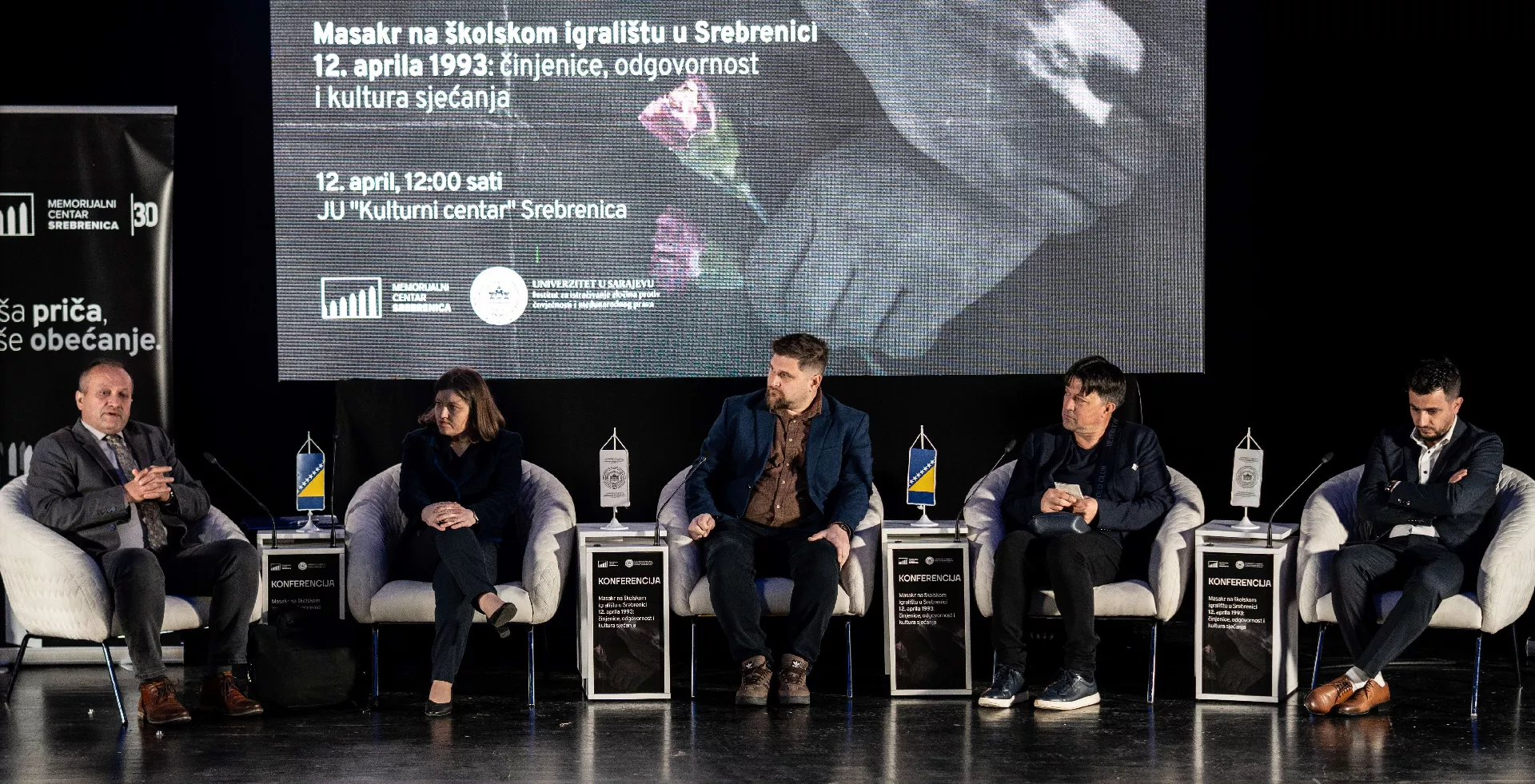
(Patria) - In Srebrenica, the conference "Massacre in the Srebrenica Schoolyard on April 12, 1993: Facts, Responsibility, and Culture of Remembrance" was held today, organized by the Srebrenica Memorial Center and the Institute for Research of Crimes Against Humanity and International Law of the University of Sarajevo.
The conference was organized with the aim of preserving the culture of remembrance, documenting facts, and pointing to the impunity of one of the largest individual crimes committed against civilians during the war in Bosnia and Herzegovina.
Despite the promise of General Philippe Morillon, commander of UNPROFOR forces, that the United Nations would protect Srebrenica, on April 12, 1993, an artillery attack was carried out on the city, during which dozens of civilians were killed in the schoolyard, while a large number were wounded. No one has been held accountable for this crime to this day.
The conference was opened by the director of the Srebrenica Memorial Center, Dr. Emir Suljagić, and the director of the Institute, Dr. Muamer Džananović.
In his address, Director Suljagić pointed out the broader significance of this crime and the lack of justice, emphasizing:
"The crime of April 12, 1993, largely defined the events that followed, including the establishment of safe zones by the United Nations Security Council. However, instead of being protected, we witnessed international forces disarming those who were victims, not perpetrators of crimes. Today, 33 years later, we are faced with the fact that there is still no judicial epilogue for this crime. We call on the competent institutions, primarily the Prosecutor's Office of Bosnia and Herzegovina, to finally approach this issue with the responsibility and integrity that the victims deserve. At the same time, I want to announce that the Srebrenica Memorial Center, in cooperation with the Institute, will soon launch a comprehensive scientific research project with the aim of establishing all the facts about this crime within the highest academic standards."
Dr. Džananović emphasized the importance of institutional cooperation, stating that "institutional cooperation between the Memorial Center and the Institute is an important contribution to a more systematic and responsible approach to confronting the past. However, this is only one step; continuous work based on verified facts, documents, and testimonies is necessary, with an understanding of the broader context of the crime."
Dr. Džananović specifically pointed to the context in which the crime was committed, including the fall of surrounding enclaves such as Kamenica, Cerska, and Konjević-Polje, the arrival of a large number of displaced civilians in Srebrenica, as well as the fact that the crime occurred shortly before Srebrenica was declared a United Nations safe zone. He also pointed out that the fact that this crime has not yet received a judicial epilogue represents not only a legal but also a serious social challenge, which leaves room for denial and relativization. Within the program, a video testimony of survivors was shown, after which two panels were held.
The first panel was dedicated to the testimonies of survivors and family members of the victims. The participants of the panel were Hasan Hasanović, Ilijaz Pilav, and Hajrudin Mešić, who spoke about the murders of civilians and the lasting consequences of this crime through their personal experiences.
The second panel brought together researchers and experts who analyzed the historical, legal, and social context of the crime. The participants of this panel were senior research associates at the Institute for Research of Crimes Against Humanity and International Law, Dr. Merisa Karović-Babić, Dr. Amir Kliko, Dr. Hikmet Karčić, as well as employees of the Memorial Center, Hasan Hasanović and Edin Ikanović.
It was concluded that it is necessary to continue systematic work on documenting facts, strengthening the culture of remembrance, and countering denial and revisionism, in order to ensure that such crimes are permanently remembered and adequately understood.
The Srebrenica Memorial Center will continue with activities aimed at preserving the truth, education, and building a responsible attitude towards the past.
Komentari (0)
Prijavite se za komentiranje
PrijavaJos nema komentara. Budite prvi!
Minuta
Sve →Iz drugih kategorija

Hoher Repräsentant nicht gewählt: Deutsche, Franzosen und Briten gegen Amerikaner, neuer Versuch Ende Juni

ČOVIĆ OHNE GNADE Wie diejenigen, die Ademović ins Amt brachten, ihm eine politische Hölle bereiteten



Sonniger Samstag, es wird recht warm


Tragödie im albanischen Ferienort: Zwei Minderjährige ertrunken