By: Muharem Cero
The speed of the collapse of Bosnian-Herzegovinian Dayton statehood is not just a feat of the internal incompetence of those who want it and the strength of obstruction of those who don't. No less, this collapse is a result of Dayton's ambiguities, gaps, and possibilities for interest-based interpretation through the lens of political goals, according to the matrix of "the worse, the better."
Collateral, destructive blows have shaken and continue to shake Bosnia from the Dayton rights of special and parallel relations of its neighbors (Serbia and Croatia), with their adjacent entities (FBiH and RS). These rights have grown into their own contradiction and have become exclusively ethnic in nature. Without hesitation, they are now interpreted as Serbian-Serbian in RS, and potentially as Croatian-Croatian in parts of FBiH perceived as exclusively Croatian ethno-territorial space. Thus reshaped, they become a powerful weapon for the destruction of the territorial integrity and sovereignty of BH statehood.
Serbian-Serbian "special" relations have, without consequence, swelled to the model of a polycentric Serbian state. The center of political decision-making from Banja Luka (and especially from Sarajevo) has visibly been relocated institutionally and in every other respect to Serbia and Belgrade.
Croatian-Croatian relations, less visible, more conspiratorial, sometimes hidden, and sometimes unnecessary, are not as institutionalized, but no less destructive and almost exclusively tied to the ideology and politics of the mother HDZ and the rigid right.
Despite apparent benignity, Croatian-Croatian "special" relations, with Croatia's entry into the EU and Brussels' convenience, have achieved institutional possibilities for action that Bosnia is yet to face and will certainly be confronted with.
Only the naive, the sleepy, and those self-absorbed can doubt that the decision on the January 9th referendum was strategically conceived precisely in the polycentric capital (Belgrade). The same naive, sleepy, and self-absorbed can doubt that this polycentric capital will also stop the implementation of the referendum in RS, as was previously conceived in the strategic plan.
How to explain this seemingly contradictory situation. Faced with The Hague's clarification of the character of the war against Bosnia and Herzegovina, pressured by the undoubtedly proven and confirmed joint criminal enterprise as its crime, Serbia, in collaboration with the Republika Srpska, devises a cunning strategy, just as it did during the war.
Ignoring the decision of the Constitutional Court of BiH on the unconstitutionality of January 9th as a holiday of "RS statehood," the NSRS, through constitutional-legal violence, calls for a referendum, relativizes Bosnian statehood, and threatens its destruction, bringing Bosnia and Herzegovina to the brink of new war conflicts.
At the same time, it presents a litmus test to the so-called international community regarding the acceptability of this act, with a predictable reaction of non-acceptance. At the point of possible escalation of conflict in BiH, it "offers its services" in a paternalistic manner. The announced referendum will certainly not happen, and the credit for this will fall like a ripe fruit into the lap of Vučić's Serbia and him personally.
Certainly, this so-called service from Vučić's Serbia is not just an act of his political catharsis but also of expected benefits, which should be known to follow.
I suspect that in the associated trade of the Vučić government's act of mercy, a much greater political favor from official Sarajevo will be sought this time.
Serbia and Vučić expect that the Bosnian authorities, and especially Bosniak politics, will stop and permanently renounce any questioning of Serbia's participation in the war against Bosnia, and with a valid act, abandon the announced reopening of the case before the International Court of Justice.
They will hold the realization of their decision on the referendum in RS until they are given valid guarantees for it.
Bosniak politics will very quickly replace the temporary satisfaction of removing the nightmare of the referendum with the nightmare of the offer of a cunning strategy of "ALL FOR NOTHING and NOTHING FOR ALL."
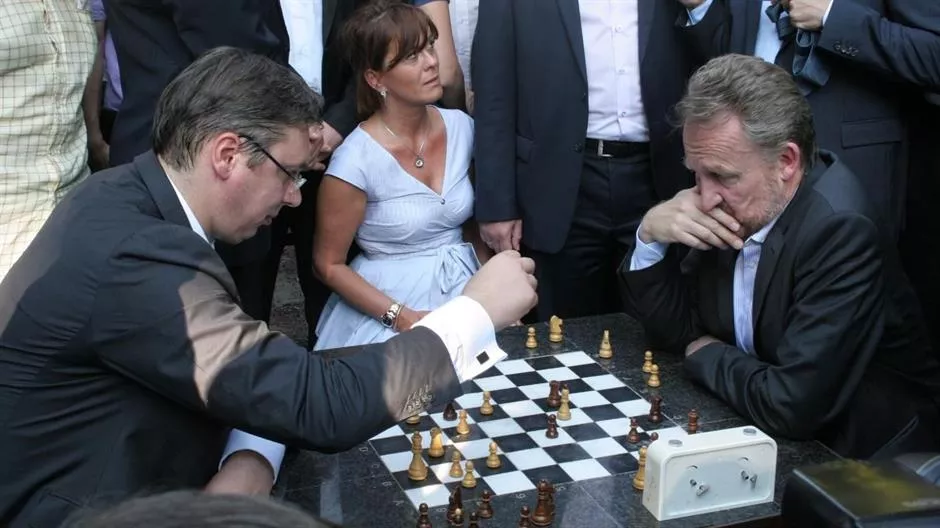
In chess slang, so dear to both Izetbegović and Vučić, one could say pawns for a king.
Vučić, I suspect, will not oblige Dodik to implement the decision of the Constitutional Court of BiH until the Bosniak political sacrifices are presented to him on a platter, this time also with a decision on Serbia's innocence in the aggression against BiH. The question remains whether any institutional entity in Bosnia and Herzegovina has the historical right to commit such a crime against truth and justice?
For this act, Izetbegović will truly need full Bosniak consensus, and certainly the consent of that famous "patriotic front" which he so desperately invoked in the fight for the alleged attempt to disappear Bosnian statehood.
Komentari (0)
Prijavite se za komentiranje
PrijavaJos nema komentara. Budite prvi!
Minuta
Sve →Iz drugih kategorija

Hoher Repräsentant nicht gewählt: Deutsche, Franzosen und Briten sabotierten Amerikaner, neuer Versuch Ende Juni

ČOVIĆ OHNE GNADE Wie diejenigen, die Ademović ins Amt brachten, ihm eine politische Hölle bereiteten



Sonniger Samstag, es wird recht warm


Tragödie im albanischen Ferienort: Zwei Minderjährige ertrunken