


Muharem Cero
The ongoing constitutional crisis in BiH, provoked by the amendments to the Criminal Code banning genocide denial and glorification of war crimes, has an agenda which is now clearly visible.
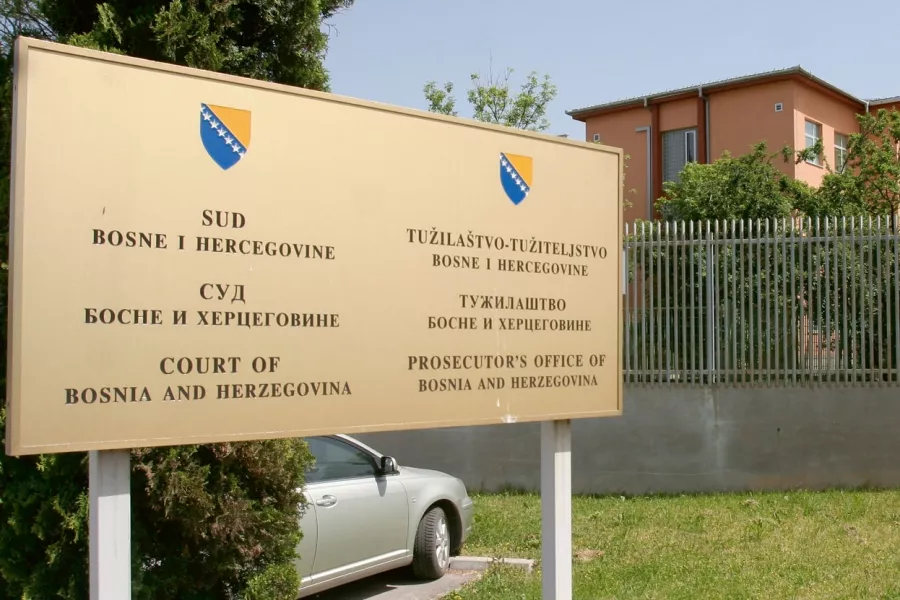
In order to achieve their goals, the creators of the crisis have used the expected changes to the Criminal Code. The real goals are extortion and blackmail by blockade in order to resolve the status of all state property (public goods and those from succession) in a way projected by the concept of a composite state.
It is not known how long the conversation between the President of the Constitutional Court of BiH Mate Tadić and the High Representative Christian Schmidt lasted, but not long enough for Tadić to acquaint the allegedly ‘surprised’ Schmidt with the way the portfolio of state property was created. Possibly by chance, the conversation itself takes place at the moment when the HDZ BiH returns to the agenda of the Federation Parliament the previously removed proposal of the Law on Construction Land in FBiH.
The proposal itself was withdrawn from the agenda of the Parliament by the proposer of the FBiH Government with late recognition that state property in various modalities of its legal continuity, by the decision to adopt the Law on Temporary Prohibition of Disposal since March 2005, has a special status and that direct and the indirect transfer of ownership of this property has been suspended, and that all possible legal actions that would have taken place should be considered legally null and void.
It remains to question the strange, but also understandable, coincidence of the HDZ's attempt and the announced decisions in the RS National Assembly. Both have the same goal - to repeal the Law on the Prohibition of Disposal of State Property and to open space for entity and cantonal devastation of the remaining part of the state land.
The spiteful one would say - the state union with joint endeavor of its constituents with the aim of desubjectivizing the property and legal sovereignty of the state of Bosnia and Herzegovina. If the Tadić-Schmidt conversation had lasted longer, the current President of the BiH Constitutional Court would probably have informed the 'confused' Schmidt about the fact that state property in his portfolio was predominantly created in a way contrary to that protected by the Convention on Human Rights and Civil Liberties which is a part of the Dayton Peace Agreement and is superior in content to the opposite provisions of the Annex 4 itself.
President Tadic would then have to explain to him that legal logic dictates the need for prior separation of nationalized property in the period after December 31, 1945, when in the ideological environment of the then system, a large number of BiH citizens lost their property due to legal violation of property (forest, agricultural land and other property), that is - confiscation.
President Tadić would probably tell Schmidt that, of all post-communist countries, BiH is still the only one that has not passed a law on restitution and denationalization, and that its adoption and the establishment of an institutional framework for implementation would make it much easier to resolve the controversial property issue.
It is not easy to agree with Tadic's message to Schmidt that the issue of state property can be resolved, as he says, 'at the state level by passing a short law on the registration of state property'. The decisions of the Constitutional Court referred to by Tadić point to the obligation to pass a law on the management and use of state property, which, due to its complexity in the case of BiH, is not just a 'short law on the registration of property'.
Anyone can see that the recommendation of the 'short law on property registration' meets those solutions to the status of state property that could be operationalized in the very intentions coming from the RS and those coming from the predictable HDZ address in Mostar.
Hopefully someone will give Schmidt an explanation that will help him paint the whole picture of state property. The Law on Restitution and Denationalization is placed in Chapter 23 of the EU candidate status, it cannot be escaped, and some claim that solutions it could bring are expected at the moment by over 300,000 legal successors of those whose property was confiscated.