Automatically translated from Bosnian.
(Patria) – The election of federal delegates could lead to the breakup of the political alliance previously agreed between SDA, POMAK and the Party for Bosnia and Herzegovina.
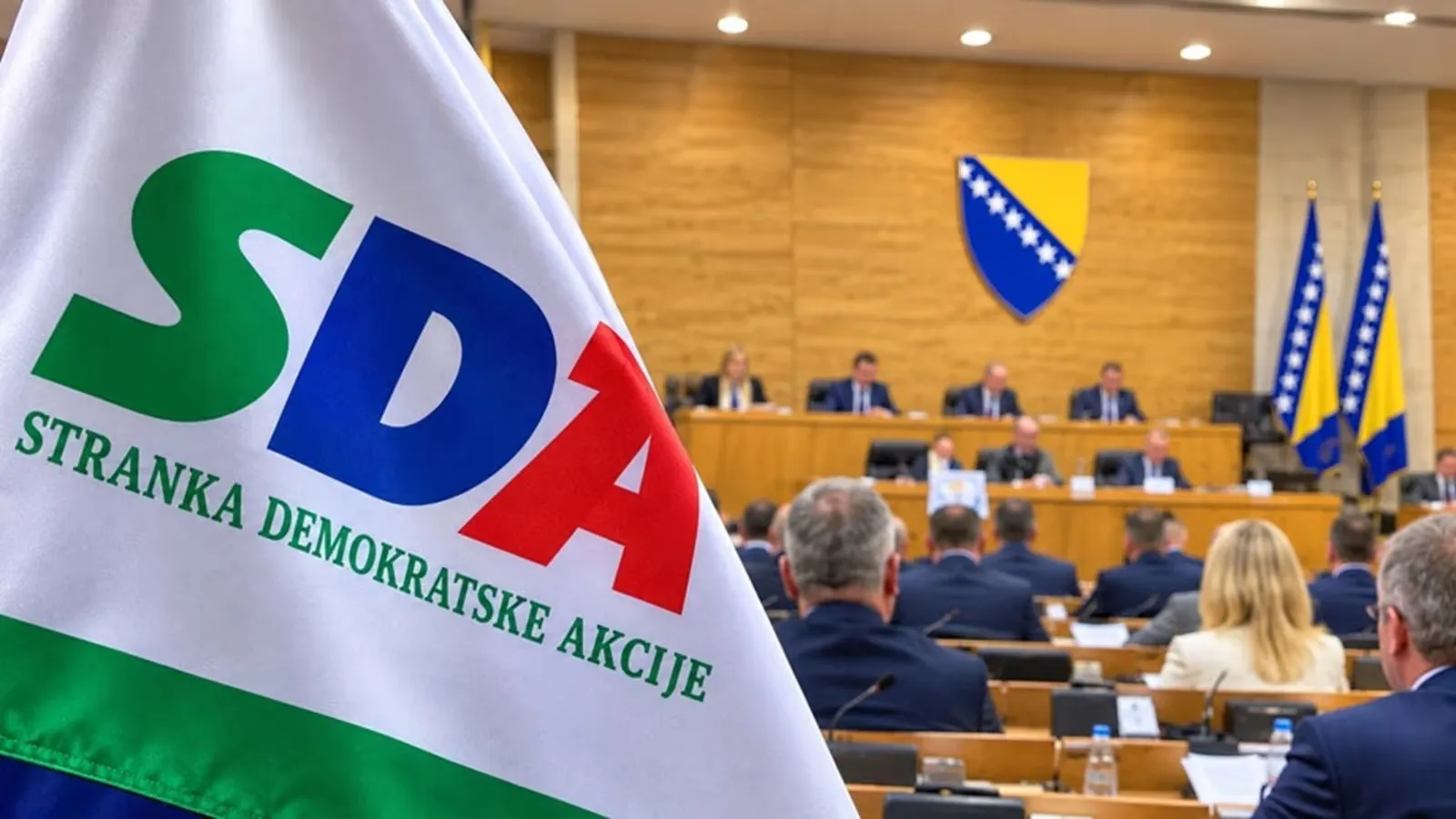
Internal turmoil within the Party of Democratic Action (SDA) could change coalition relations in the Una-Sana Canton and jeopardize an agreement to form a new cantonal government that was reached even before the general elections.
The cause of the disagreement, according to the news portal Krajina.ba, is the election of delegates to the House of Peoples of the Parliament of the Federation of Bosnia and Herzegovina, for which as many as three separate candidate lists have been put forward by SDA ranks.
Three delegates to the Bosniak Caucus of the Federation’s House of Peoples are elected from the Una-Sana Cantonal Assembly, and five candidate lists have been registered for the positions.
The People’s European Union (NES) and the Party for Bosnia and Herzegovina have their own lists, while the remaining three are linked to SDA and are headed by Abid Mulalić, Mehmed Mahmić and Zinajda Hadžić.
SDA has nine Bosniak representatives in the USK Assembly, while NES has six.
Unlike NES, which united its representatives behind a single candidate list, SDA will have to coordinate the distribution of votes among three lists while also taking into account the commitments it previously made to coalition partners.
It is particularly telling that Asmir Ćufurović, head of the SDA parliamentary group in the USK Assembly, is also on Abid Mulalić’s list.
The question remains how many SDA representatives support Mulalić’s candidacy, and what level of support Mahmić and Hadžić have within the party.
Dividing SDA’s nine votes among three candidate lists could jeopardize not only the election of its candidates but also the implementation of the political agreement with the Party for Bosnia and Herzegovina.
According to information from political circles, the leaderships of SDA and the Party for Bosnia and Herzegovina in Sarajevo previously reached an agreement under which some SDA representatives in the USK Assembly would support the SBiH candidate list for the Federation’s House of Peoples.
POMAK representatives were also expected to support that list.
This agreement is part of a broader political arrangement between the three parties, which includes forming the cantonal government as well as mutual support in the allocation of mandates at the Federation level.
The Party for Bosnia and Herzegovina previously supported, according to the same information, a political arrangement concerning the allocation of a compensatory mandate to Rusmira Konjević of POMAK in the House of Representatives of the Parliament of the Federation of Bosnia and Herzegovina.
In negotiations to form the new cantonal government, the Party for Bosnia and Herzegovina agreed to one ministerial post and one delegate position in the Federation’s House of Peoples.
The election of delegates is precisely what should show whether SDA will honor its part of the agreement.
Sources in political circles close to the Party for Bosnia and Herzegovina’s headquarters in Sarajevo say that if SDA representatives fail to provide the agreed support for the SBiH list, negotiations to form a government in Una-Sana Canton could be suspended.
This would also call POMAK’s position into question, as it had negotiated the formation of a new cantonal majority with the two parties.
Political circles in the Krajina region are already discussing the possibility that SDA could open negotiations with the SDP and People and Justice if the current agreement falls through.
Those two parties together have five representatives in the USK Assembly.
Any negotiations with them would represent a departure from the political arrangement that SDA, POMAK and the Party for Bosnia and Herzegovina had been negotiating even before the elections.
Meanwhile, Una-Sana Canton is facing serious problems in education and healthcare.
A general strike has been underway in secondary schools since November 9. First-, second- and third-year students have not attended classes for nearly three weeks, while the prescribed minimum of instruction has been ensured for final-year students.
So far, talks have not resulted in an agreement that would meet the education workers’ demands and enable classes to resume regularly.
The financial condition of the Cantonal Hospital in Bihać, burdened by accumulated debts running into the millions, is an additional problem.
Ensuring the financial stability of USK’s largest healthcare institution, settling its obligations and ending the education workers’ strike will be among the most important tasks of the future cantonal government, whose formation has now been further complicated by disagreements over the election of federal delegates.
Komentari (0)
Prijavite se za komentiranje
PrijavaJos nema komentara. Budite prvi!
Minuta
Sve →Iz drugih kategorija
SDA on the Brink of a Split in Krajina: Three Candidates for the House of Peoples Call the Formation of the Una-Sana Canton Government into Question

November is passing, but there are no indictments: Were promises to prosecute crimes in Sarajevo a deception?