
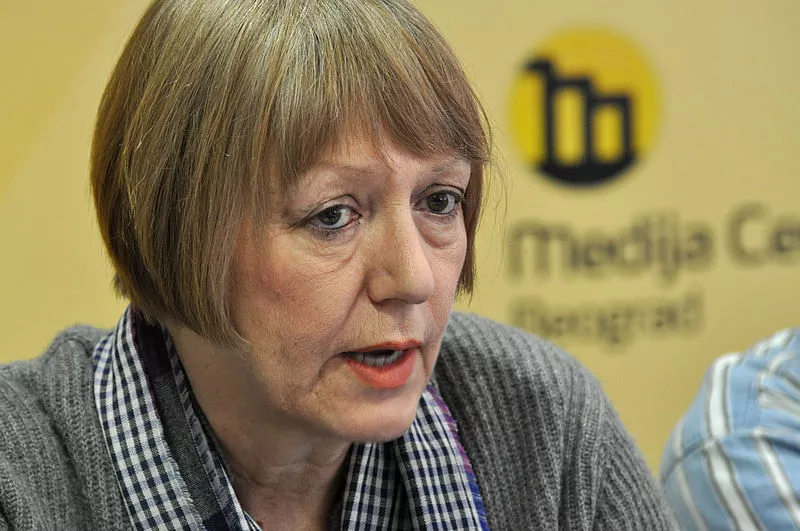
Sonja Biserko, president of the Helsinki Committee for Human Rights in Serbia, commented on the case from Priboj in which, during a celebration party, a police officer called for a repeat of the genocide in Srebrenica. As she says, it is not a coincidence that this is happening right there, and that the Bosniak population in BiH and Sandžak is constantly kept in tension.
She also pointed at a relation between the latest developments in the region and the current international constellations, emphasizing that ‘Serbia believes that this is a historic moment for completion of the project called Serb world’.
Bosniaks are still the target group, with Sandžak considered a point on the so-called ‘Green transversal’. After cleansing eastern Bosnia of Bosniaks in the early nineties, Sandžak still remains a compact area inhabited by Bosniaks. It is no coincidence that this is happening there and that these songs are sung by the police, that is, the state body, and not just the football fans or radical groups. Therefore, it is directly done by a very important institution of the system’, Biserko points out for N1.
However, it is no coincidence that Ukraine and BiH are being radicalized at the same time and in a similar way, Biserko continues. She reminds that both points represent a very important and fragile strategic location where Russia is testing its strength and cohesion of the EU in the defense of its spheres of interest.
‘The question is to what extent the EU can stand in the way of radicalization promoted daily by Dodik with the support of both Belgrade and Russia. The populization of the public sphere, above all, targets the Bosniak population in the region. It is not just a part of folklore or a denial of crimes’, she warns.
She also stated that Serbia has not ended the war, it is only waging it by other means - diplomatic, but also various others. International constellations are also in its favor, which Serbia reads very well, Biserko thinks.
‘Serbia believes that this is a historic moment when the project so-called Serb world can be completed. The Bosniak population has been perceived for many years as a disruptive factor. I was in Sandžak recently and I can say that people feel more insecure than 10, 15 years ago. They are disappointed that the state did nothing to shed light on the crimes that took place in the early nineties - to the contrary, it was all covered up’, Biserko explains.
She thinks that the disappointment of this minority stems from the fact that their integration into the wider political, social and economic context has not taken place, and that they are totally segregated and isolated.