
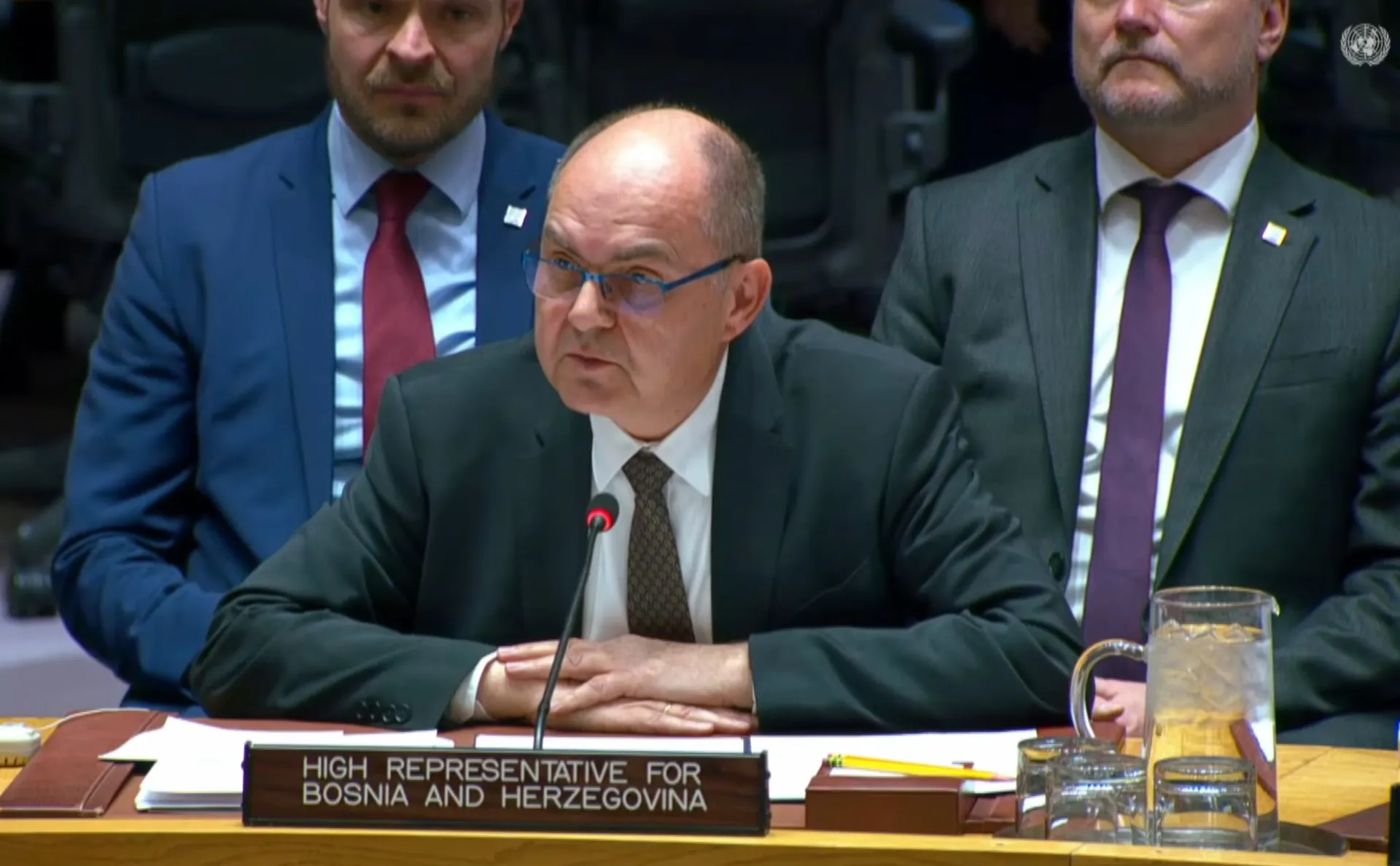
(Patria) - Outgoing High Representative Christian Schmidt presented the 69th report on the implementation of peace in BiH to the UN Security Council today, warning that constant blockades and challenges to state institutions lead to the "quiet deconstruction" of the country.
The UN Security Council session is being held at one of the most tense political moments since the signing of the Dayton Peace Agreement, marked by the announcement of Schmidt's departure, blockades of state institutions, and ongoing disputes over the future of international supervision in BiH, reports N1.
Before Schmidt's address, Russia's Deputy Permanent Representative to the UN, Anna Evstigneeva, requested his recusal, reiterating Moscow's stance that it does not recognize the legitimacy of the High Representative.
In the report, covering the period from October 16, 2025, to April 15, 2026, Schmidt stated that the overall security situation in BiH remains "stable but fragile".
He emphasized that the stabilizing role of EUFOR remains important, especially in cooperation with the Office of the High Representative (OHR), while political crises and disputes continue to burden the functioning of the state.
At the same time, he warned that disagreements over the Dayton Peace Agreement continue to affect BiH institutions and are "slowly leading to their deconstruction".
Schmidt stressed that the leadership of the BiH entity of Rs continues to question the territorial integrity of Bosnia and Herzegovina, with "increasingly confrontational political rhetoric" which, according to the report, openly targets Bosniaks on an ethnic and religious basis.
He stated that the stagnation of state institutions is used as an argument for devolving competencies to lower levels of government and for claims that BiH is not a viable state.
He specifically highlighted the refusal of the Rs authorities to appoint judges to the Constitutional Court of BiH, as well as the rejection of that court's decisions.
In the report, he also stated that the blockade is most visible in the House of Peoples of the Parliamentary Assembly of BiH, where quorum rules are used as a "blockade mechanism".
Therefore, Schmidt pointed out, numerous laws adopted in the House of Representatives are awaiting confirmation in the House of Peoples, including those necessary for holding the first intergovernmental conference with the European Union and starting accession negotiations.
Schmidt warned that other state institutions are also suffering from politically motivated obstructions that prevent them from fulfilling their constitutional and legal obligations.
He also assessed that the budget of BiH institutions has been used for years as a means of weakening them: "BiH institutions were on temporary financing throughout 2025, and the same problem continued at the beginning of 2026."
According to the report, the budget of state institutions has been stagnating for over a decade despite growing obligations and inflation, while entity budgets are significantly increasing.
Schmidt warns that the consequences are particularly felt in the defense and security sectors. He specifically highlighted the financial crisis of BHRT in the report.
Schmidt also warned that the eventual cessation of the state public broadcaster's operations would represent another step in the process of "creeping deconstruction of the state's institutional framework".
He also stated that the current public broadcasting system, established after the war to prevent the abuse of media that existed in the early nineties, shows serious weaknesses.
He also touched upon the early elections for the president of Republika Srpska, held in November 2025 and February 2026, following the final verdict against Milorad Dodik.
He reminded that the Central Election Commission (CEC) of BiH annulled the results in some polling stations due to "widespread fraud" and irregularities.
According to the report, the elections showed serious weaknesses in the electoral system, including voter impersonation and voting without valid identification.
Therefore, Schmidt once again supported the introduction of voter identification technologies and electronic vote counting before the General Elections in 2026.
The report also states that the media environment in BiH, especially in Rs, remains restricted.
Schmidt warns of political influence over public services and parts of private media, as well as the intimidation of journalists through legal pressure, hostile rhetoric from officials, and restrictions on access to official events.
An additional problem, he stated, is the reduction in funding from international donors for smaller and independent media outlets.
In one of the harshest parts of the report, Schmidt emphasizes that BiH is undergoing a "quiet erosion of democratic standards".
He assesses that some political elites prioritize maintaining political control over institutions rather than compromise, the rule of law, and European integration.
He describes corruption as a "serious and persistent problem", deeply rooted in public institutions and daily life.
He also states that, despite political crises and the "deconstruction of the institutional order", citizens, civil society, local communities, and the private sector show "exceptional social resilience" that can help the country overcome stagnation.
Komentari (0)
Prijavite se za komentiranje
PrijavaJos nema komentara. Budite prvi!
Minuta
Sve →Iz drugih kategorija

High Representative Not Elected: Germans, French and British Against Americans, New Attempt at End of June

ČOVIĆ WITHOUT MERCY: How Those Who Brought Ademović to Office Created a Political Hell for Him



Sunny Saturday, quite warm



Tragedy in Albanian resort: Two minors drown












