
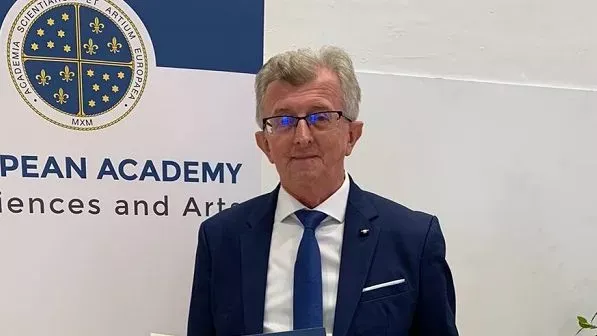
Written by: Accad. Prof. Dr. Nedim Suljić
The statement by journalist Ranko Mavrak reflects a deeply rooted, pragmatic view of the current ethnopolitical reality in Bosnia and Herzegovina. However, from the perspective of long-term preservation and strengthening of the statehood of Bosnia and Herzegovina, such a narrative requires serious and reasoned deconstruction.
Accepting the thesis that political life in BiH is permanently reduced exclusively to ethnic blocs represents a renunciation of European and democratic standards. Statements like the one made by journalist Ranko Mavrak are a classic example of reducing the constitutional order of Bosnia and Herzegovina to the level of ethnic tribes. This narrative is not only analytically flawed but is deeply anti-European and directly opposed to fundamental democratic principles.
Mavrak's recent statement that "the Bosniak electorate chooses between Bećirović and Izetbegović" reduces the citizens of Bosnia and Herzegovina to mere members of ethnic pens, denying their individual, civic, and political capacity. A state cannot be preserved in the long term if its democracy is viewed solely through the prism of tribal counting. Preserving Bosnia and Herzegovina requires building a society in which political will is not determined exclusively by bloodlines or ethnic prefixes, but by the quality of political programs and loyalty to the state of Bosnia and Herzegovina.
The thesis that "the Bosniak electorate should not interfere in the election of Croats" represents a blatant ignorance, or more likely a deliberate distortion, of the Constitution of Bosnia and Herzegovina. According to the current Election Law and Constitution, the citizens of the Federation of BiH constitute one electoral unit that elects two members of the Presidency (one from the Bosniak people and one from the Croatian people). There is no "Croatian" or "Bosniak" ballot box, Mr. Mavrak. Every citizen of the Federation of BiH entity, regardless of ethnic affiliation, has the inalienable right to vote for any candidate on the list. Using the term "interference" for the act of exercising a basic democratic voting right is a dangerous precedent that attempts to legalize ethnic apartheid on the ballot for the October general elections.
Journalist Ranko Mavrak's comment that "Slaven Kovačević has no prospects" completely misses the political essence of his candidacy. The presence of Dr. Slaven Kovačević on the ballot for the member of the BiH Presidency from the Croatian people is a direct reminder that Bosnia and Herzegovina must move from the phase of Dayton ethnic representation to the phase of Brussels civic representation. Reducing his role to mere mathematical prospects is an attempt to devalue what he legally represents, which is the equality of every citizen in every inch of Bosnia and Herzegovina. Mavrak's statement reduces hundreds of thousands of citizens to an amorphous ethnic mass supposedly programmed to choose only between two candidates (Bećirović and Izetbegović). This approach deliberately ignores the existence of a huge civic and supranational electorate in the FBiH entity – people who do not vote according to the dictate of bloodlines, but according to ideological, social, and state-building preferences. Democracy in the state of BiH must not and cannot be reduced to a tribal census on election day.
Ranko Mavrak claims that the election of Mr. Željko Komšić "antagonized relations" and "poisoned the atmosphere." This is a classic bait-and-switch, because the atmosphere in BiH is not poisoned by citizens exercising their democratic right to vote. The atmosphere is poisoned by policies of blackmail, blocking institutions (the House of Peoples of the BiH Parliamentary Assembly, which has been blocked by HDZ and SNSD for two years), threats of territorial reorganization, and refusal to implement the judgments of the European Court of Human Rights by those forces that want an exclusive monopoly on the political representation of peoples, namely the HDZ led by Dragan Čović. A member of the BiH Presidency must be accountable to the state of Bosnia and Herzegovina and its citizens, not to neighboring countries or a single political party.
In his analyses, Mavrak consistently uses, legitimizes, and promotes the terminology of the HDZ BiH. The concept of "legitimate ethnic representation," which does not exist in European legal practice, he presents as a fundamental condition for the functioning of BiH. Every political option or individual (such as Slaven Kovačević or Željko Komšić) advocating for a civic state is regularly labeled by Mavrak and journalists like him as "Bosniak hegemonism" or "unitarism," which is identical to the vocabulary used by Dragan Čović and Andrej Plenković.
Through the form of so-called "rational and objective journalistic analysis," Mr. Mavrak actually normalizes and justifies ethnic segregation. When a journalist (Ranko Mavrak) publicly says that "the Bosniak electorate should not interfere in the election of Croats," he directly undermines the Constitution of the Federation of BiH and promotes the idea of dividing the country into ethnic electoral units.
Based on the statement he gave to BHTV, I am of the opinion that Ranko Mavrak functions as a media liaison officer between HDZ policy and the wider public. His task is to package anti-civilizational, discriminatory political demands (such as those about ethnic voting) in the cellophane of legitimate political analysis. For the preservation of the statehood of Bosnia and Herzegovina, such narratives are extremely toxic, because they directly attack its only path to survival – transformation into a modern European democracy based on individual rights.
Narratives that reject the civic state as an "unrealistic utopia" directly play into the hands of those policies that want to prove that Bosnia and Herzegovina is an "impossible state." A functional state requires institutions that protect every citizen in every part of its territory, not a system in which people are hostages of ethnic quotas and territorial divisions. The struggle for a civic BiH is not the exclusive right of one people, but the only integrative factor that can ensure the internal cohesion of the country.
Statements coming from agencies like HINA (where Ranko Mavrak is also editor-in-chief) often serve as intellectual artillery for the political goals of official Zagreb. Not responding to theses such as Mavrak's statements means tacitly ceding sovereignty over one's own electoral process to neighboring states. And Mr. Mavrak, the entry of Dr. Slaven Kovačević into the BiH Presidency would mean a direct, practical victory of the civic concept at the highest level of state authority. The election of Dr. Slaven Kovačević would permanently shatter the myth of the HDZ and similar policies about the exclusive right to the non-existent constitutional term "legitimate representation of peoples." The BiH Presidency would gain a member who openly and legally argues for the interests of all citizens of the state of Bosnia and Herzegovina, not just one ethnic group or one political party headquartered in another state.
The constitutional framework that forces people to vote only for "their own" ethnic leaders is a generator of constant crises, and this is precisely what this journalist initiates. The reaction to such media analyses must be clear: Bosnia and Herzegovina will survive only if its electoral legislation and constitutional order evolve from the Dayton straitjacket into a modern European state. Otherwise, agreeing to the thesis that there are only "Bosniak," "Serb," and "Croat" electorates means tacit consent to the permanent division of the country.
Agreeing to the narrative that in this country there are only "our," "their," and "foreign" voters means abandoning the idea of a modern, European Bosnia and Herzegovina. Elections are not a process in which peoples are divided, but a process in which citizens choose a vision of the state. Preserving Bosnia and Herzegovina requires expanding the civic space, not retreating into imposed ethnic pens as suggested by certain analysts from the neighborhood.
Komentari (0)
Prijavite se za komentiranje
PrijavaJos nema komentara. Budite prvi!
Minuta
Sve →Iz drugih kategorija

High Representative Not Elected: Germans, French and British Against Americans, New Attempt at End of June

ČOVIĆ WITHOUT MERCY: How Those Who Brought Ademović to Office Created a Political Hell for Him



Sunny Saturday, quite warm



Tragedy in Albanian resort: Two minors drown












