
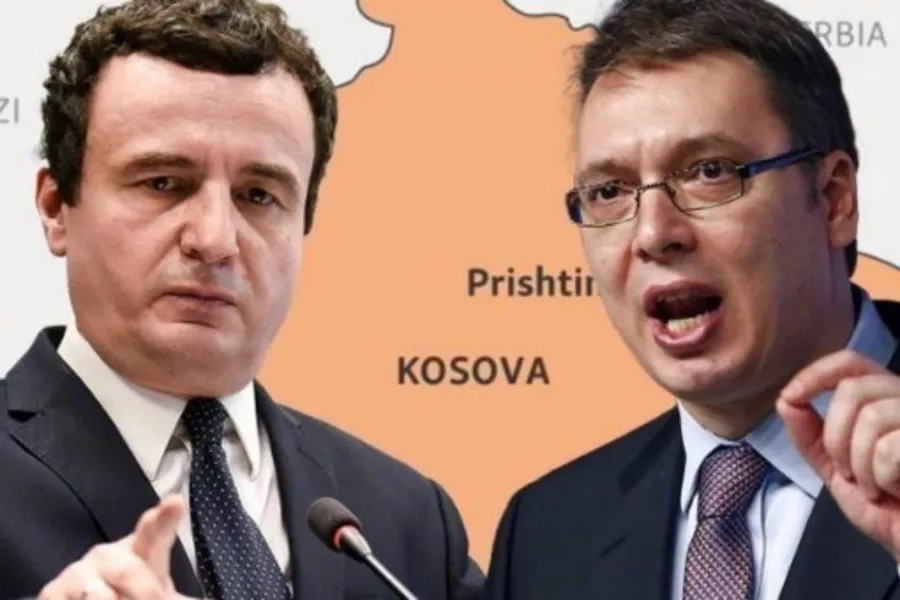
By Rasim Belko
Strategic goals of Russia in the Western Balkans, highlighted through serious threats to all countries that have planned, become, or are on the verge of becoming NATO members, are a roadmap for how the West can simply resolve one of the threats of destabilization. Because, framing the Balkans as a NATO space means stopping any future attempt at territorial pretensions by Belgrade, either independently or on Russia's orders.
And NATO is indeed the guarantor of peace in the Balkans, therefore the process should be completed with the full integration of Bosnia and Herzegovina. However, for the stabilization of this region, geostrategically interesting to opposing titans, a political realignment and grouping of interests is necessary for all those who experience problems and destabilization originating from a single source.
The policy that Belgrade is the center of regional power and as such a strategic partner in preserving regional peace and stability has been proven wrong by the West's approach. Because, Belgrade is a clearly visible destabilizing element in its view of all countries in the region, and if its pro-Russian and hegemonic aspirations were curbed, the Western Balkans would be a space of economic and all other prosperity, as it would finally be a peaceful, democratic area.
However, the fact that the US, as well as EU partners, are still not ready to strip Belgrade of its partner title should be sufficient motivation and impetus for the countries of the region to turn towards mutual interconnection of political and strategic stances.
Aleksandar Vučić and Serbia are provoking and causing problems, from Ljubljana, through Zagreb, Skopje, Pristina, to Podgorica, with occasional harassment of Tirana as well. Considering that Ljubljana, Tirana, and Zagreb have largely escaped Serbia's destabilizing radars, it is quite clear that a pact for stability must be created through the connection of Skopje, Pristina, Sarajevo, and Podgorica.
These four cities are individually trying to cope with a wide range of imposed political wars, created in Belgrade, with the aim of keeping the region a paralyzed powder keg for as long as possible. And the question is why there hasn't been a clear union of authorities in these four centers so far, which would then unitedly oppose the hegemony with a Russian stamp.
Because, Vučić has united all Serbs in the region in the project of a Serbian world loyal to the Russian tyrant, and the ability to wage a war on broad and diverse fronts is given to him precisely by the fact that there is no common response.
North Macedonia and Montenegro are NATO members, but that is not enough for them to develop a strong resistance mechanism against Belgrade's attacks. Sarajevo is exposed, just like Pristina, which, due to its disobedience to dictated concessions, is targeted even by Western centers of power.
And that is precisely why it is necessary for pro-state policies in all four centers to unite and resist. This unification would inevitably change the attitude and behavior of Western centers of power towards the region, because then we could clearly see who is for peace and who is fulfilling Putin's wishes.
No one guarantees Sarajevo and Podgorica that Kosovo barricades will not become their problem tomorrow. No one guarantees them that the fact that they, like Albin Kurti, are being persuaded into rotten compromises will not lead to the disintegration of their respective states.
And that Kurti is a new force, which the four aforementioned political centers must use as an epicenter around which to unite their interests. Their passivity has brought them nothing good, and watching Pristina try to fight Serbian and Russian imperialism alone, with the absence of clear Western resolve, is a roadmap for how Sarajevo, Podgorica, and Skopje will fare in the near future.
And this is not a call for political grouping to attack someone, but a call to unite and create a Balkan resistance movement against Serbian-Russian hegemony.
“I think many of our misfortunes and many of our challenges and problems have the same cause. And that is why I think that Sarajevo, Podgorica, Pristina, Skopje, Tirana should cooperate in terms of this common cause of our problems, especially in terms of peace and security,” says Kurti.
Because, Kurti perhaps sees that source of problems better than others. Kosovo has not yet resolved its wars, whether political or armed, so Kurti's eyes are more open. Others are partially occupied with artificial crises, and partially lulled into forming coalition knots for power.
But, if they do not want to be oppressed under the Serbian world from which they fled through bloody paths in the nineties, they must find a common path to solving the source of the problem for all of them. Because, without much analysis, it is evident that Serbia is the biggest destabilizer in the Balkans. Sometimes it does so by relying on Russia, sometimes on favorable policies within the EU, and sometimes on Escobar and the miscalculations of the US.
‘Open Balkan’ is slowly heading to its deserved place, the dustbin of history. Let a new story be an interconnected Balkans, which Serbia can control, because such a Balkans will be an attractive investor, for NATO, for the EU, and far from the paw of the Siberian bear, which has been lurking for too long and too dangerously!
Komentari (0)
Prijavite se za komentiranje
PrijavaJos nema komentara. Budite prvi!
Minuta
Sve →Iz drugih kategorija

High Representative Not Elected: Germans, French and British Sabotaged Americans, New Attempt at End of June

ČOVIĆ WITHOUT MERCY: How Those Who Brought Ademović to Office Created a Political Hell for Him



Sunny Saturday, quite warm



Tragedy in Albanian resort: Two minors drown












